
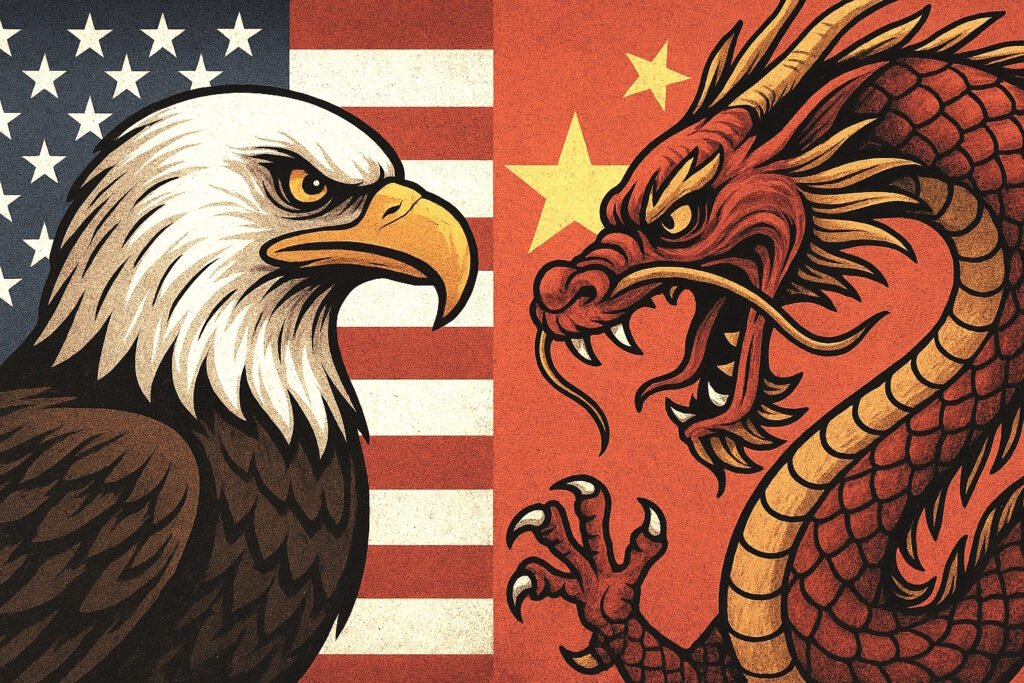
I. Introduction
“The last capitalist we hang will be the one who sold us the rope.” This phrase, often attributed to Karl Marx—though it does not appear verbatim in his major works—has long served as a metaphor for capitalism’s built‑in tendency toward self‑destruction. In this article, the “rope” is understood as control over the global market. By championing globalization, the United States effectively sold the rope and gradually surrendered the very instrument of its hegemony to China.
The supposed Marxist aphorism captures the contradictory logic of capitalism: in the pursuit of profit, the capitalist may hand over to his adversary the means of his own undoing. For the United States, globalization was conceived as a mechanism to consolidate supremacy after the Cold War. Yet the opening of markets transferred economic and technological power to China. The paradox is striking: the global market, designed as an instrument of American dominance, became the weapon of its chief ideological rival.
II. China as the Ideological Heir of the USSR
China’s economic rise cannot be understood without considering its ideological dimension. After the Revolution of 1949, the Chinese Communist Party adopted Marxism‑Leninism as its official doctrine, in close alignment with the Soviet Union. For decades, the USSR served as model and mentor: advising on centralized planning, transferring technology, and supporting the construction of heavy industry. Yet ideological and cultural tensions soon revealed differences. The Sino‑Soviet split of the 1960s made clear that China was unwilling to remain a mere satellite; instead, it sought to reinterpret the socialist legacy through its own traditions.
Unlike the USSR, which emphasized Marxist‑Leninist orthodoxy and absolute centralization, China introduced nuances rooted in its millennial history and the centrality of the state in political culture. Maoism, with its focus on peasant mobilization and the Cultural Revolution, was a localized adaptation of socialism. Later, under Deng Xiaoping, an unprecedented synthesis emerged: the Communist Party retained political monopoly while opening the economy to market forces. This formula—“socialism with Chinese characteristics”—made China both the ideological heir of the USSR and the innovator of a hybrid model that combined state planning, economic pragmatism, and cultural continuity.
In this sense, China inherited from the USSR the conviction that the state must direct development and control strategic sectors. But it did so with a pragmatism the Soviets never achieved: welcoming foreign investment, allowing private initiative in certain areas, and using the market as a tool of national strengthening. The Confucian tradition of hierarchy and social harmony intertwined with Marxism‑Leninism, producing a singular model that explains why China could harness globalization without losing political control. Rather than a mere copy of the USSR, China became both its heir and its critic, capable of resignifying socialism in national and cultural terms.
III. From Soviet Legacy to State Capitalism: Deng Xiaoping’s Reforms
China’s trajectory shows how a nation that proclaimed itself the heir of Marxism‑Leninism ultimately consolidated a hybrid model that combined political planning with economic openness. After the Sino‑Soviet split in the 1960s, the Chinese Communist Party maintained ideological monopoly but introduced a pragmatism the USSR never achieved. Under Deng Xiaoping, the formula was redefined: “It doesn’t matter whether the cat is black or white, as long as it catches mice”—a proverb famously cited by Deng Xiaoping to illustrate China’s pragmatic turn. This maxim encapsulated the transition to a system in which the market became a tool of the state rather than its replacement.
In December 1978, Deng launched the program of “Reform and Opening” (gaige kaifang), transforming China from a closed, centralized economy into a hybrid system of “socialism with Chinese characteristics.” The first Special Economic Zones—such as Shenzhen and Zhuhai—were created to attract foreign investment. Between 1978 and 2000, China’s GDP grew at annual rates above 9 percent. Foreign direct investment rose from barely $57 million in 1980 to more than $40 billion by 2000. American companies began setting up factories in China, drawn by low labor costs and a potential market of hundreds of millions of consumers.
This so‑called “socialism with Chinese characteristics” translated into the creation of state capitalism: a model in which private and foreign firms operate under Party supervision, while strategic sectors—energy, telecommunications, infrastructure, defense—remain firmly under state control. Foreign capital was welcomed, but always subordinated to national objectives. The Chinese state did not relinquish its role in directing development; instead, it used the market as an instrument to strengthen its power.
State capitalism consolidated itself in three dimensions. First, through mixed ownership, where state enterprises coexist with private capital but strategic decisions emanate from the Party. Second, through long‑term planning, with five‑year plans channeling investment into priority sectors such as technology, renewable energy, and artificial intelligence. Third, through the accumulation of reserves and financial control, enabling the state to intervene in the global economy without losing autonomy.
In this sense, China diverged both from Soviet orthodoxy and from American liberalism. While the USSR clung to absolute centralization and the United States trusted in free markets, China built an intermediate model: state capitalism that combines political discipline, economic pragmatism, and cultural continuity. This formula explains why China could harness globalization without losing political control—and why today it challenges global hegemony from a position of strength.
IV. The American Gamble in the 1990s
After the Soviet collapse, Washington promoted global liberalization under what became known as the “Washington Consensus.” The Clinton administration defended the idea that trade would lead to China’s democratization, underestimating the state’s ability to control the process. By 1999, bilateral trade had already reached $95 billion, with a growing deficit for the United States. The bet was clear: integrate China into the global market designed by the West. In Clinton’s words, “By opening trade with China, we are exporting freedom.” The outcome proved otherwise.
The American miscalculation was twofold. First, it assumed that victory in the Cold War had consolidated a unipolar order in which market liberalization automatically meant the expansion of liberal values. Second, it believed that China’s incorporation into the global system would transform it into a dependent partner, incapable of challenging market control. Yet while Washington celebrated its hegemony, Beijing used openness to strengthen its model of state capitalism.
The first Chinese companies to benefit from this process illustrate the paradox. Sinopec and PetroChina, in the energy sector, grew with state support and access to foreign capital. China Telecom and China Mobile expanded in telecommunications, modernizing through liberalization without losing political control. Even Lenovo, founded in 1984, began projecting itself internationally in the 1990s, backed by policies of technological transfer. These firms did not become mere extensions of the Western market; they became instruments of the state to accumulate economic and strategic power.
Thus, while the United States believed it had won the Cold War and that globalization would consolidate its supremacy, China was using that same globalization to build its own economic apparatus. The global market, far from being a neutral space under American control, became the terrain where Chinese state capitalism took root. The rope Washington had sold—the control of the market—was beginning to tighten in the hands of its future rival.
V. Timeline of the Conflict
The consolidation of state capitalism in China during Deng Xiaoping’s reforms and the expansion of the first national enterprises coincided with America’s miscalculation in the 1990s: believing that globalization was simply an extension of its Cold War victory. From that point onward, the milestones in the relationship between the two countries reveal how the structure of the global market—originally designed by Washington—progressively shifted into Beijing’s hands. The following chronology synthesizes the key moments of that transformation.
V.1. 2001: China Joins the WTO
China’s accession to the World Trade Organization (WTO) in December 2001 was a decisive turning point. In 2000, China accounted for barely 3.5% of global trade; by 2015, it had reached 11%, surpassing the United States. Foreign trade came to represent 40% of China’s GDP, consolidating its export‑driven model. American companies massively relocated production—textiles, toys, electronics, and later technological components—to Chinese territory.
V.2. 2000–2010: The Rise of the Monster
Between 2001 and 2010, Chinese exports grew from $266 billion to $1.58 trillion. In 2008, China overtook Germany as the world’s largest exporter. The trade surplus with the United States skyrocketed: in 2005 it reached $202 billion, and by 2010 it exceeded $273 billion. China accumulated more than $3 trillion in foreign reserves, even financing part of U.S. debt. The economic monster had been spawned—and it had done so through the very openness promoted by Washington.
V.3. The “China Shock” in the United States
The impact on American industrial employment was devastating. Between 1990 and 2007, competition from Chinese imports explained roughly one‑quarter of the decline in U.S. manufacturing jobs. Research by Autor, Dorn, and Hanson (2013) documented that regions most exposed to Chinese imports suffered higher unemployment, wage declines, and social deterioration. The promise that globalization would benefit everyone turned into a domestic social and political crisis, fueling resentment and polarization. The “China shock” became a central concept in explaining the rise of populism in the United States.
V.4. 2010–2020: Open Dispute
By 2012, China had surpassed the United States as the world’s leading trading power. The U.S. trade deficit with China reached nearly $300 billion in 2023. Under the Trump administration, Washington launched a trade war: tariffs, technological restrictions, and sanctions against Huawei. The Biden administration continued with “decoupling” policies in strategic sectors such as semiconductors and artificial intelligence. The paradox became undeniable: the global market, once the instrument of American hegemony, had become China’s weapon to contest that very hegemony.
VI. Theoretical Reflections: Hegemony and Contradiction at the Point of No Return
The Marxist metaphor comes full circle: in its relentless pursuit of profit, American capital sold China control over the global market. The transfer of production and technology empowered China, which skillfully used openness to consolidate a hybrid model of planning and market. Far from liberalizing, the Chinese state turned globalization into an instrument of power, subordinating foreign capital to national objectives and reinforcing its system of state capitalism.
Giovanni Arrighi had already warned in Adam Smith in Beijing (2007) that China’s rise represented a shift in global hegemony. Immanuel Wallerstein, through world‑systems theory, argued that globalization redistributes power in historical cycles. Within this logic, the displacement of the United States by China is not an accident but part of a structural reconfiguration. Today, the United States faces a rival that dominates strategic sectors and controls global supply chains—from semiconductors to the energy transition.
The pressing question is whether this situation can be reversed. Everything suggests it cannot. Economic interdependence, the sheer scale of the Chinese market, and the accumulation of reserves make it impossible to turn back without dismantling decades of global integration. Sanctions and tariffs may slow the process but cannot undo it. This is why some voices in the United States have gone so far as to suggest that the only way to defeat China would be through direct war. Yet such an option is less a strategy than a symptom of desperation: an open conflict would be catastrophic for both, given the interconnection of their economies and the risk of nuclear escalation.
What is already visible is a hybrid war in progress: technological, with restrictions on semiconductors and artificial intelligence; financial, with attempts to limit China’s access to capital and Western markets; and geopolitical, through regional alliances aimed at containing its influence. None of these tactics, however, erase the central fact: American hegemony has been eroded, and China’s rise is structural. The global market is already in Beijing’s hands, and what lies ahead is not reversal but the management of a prolonged struggle for world power.
Against this backdrop, some Western analysts have proposed alternatives less fatalistic than war or absolute decoupling. They speak of competitive coexistence, where the United States and China maintain strategic rivalry but avoid a total rupture of supply chains; of regulated multipolarity, with international institutions cushioning the hegemonic clash; or even of pragmatic regionalization, in which blocs such as the European Union or Latin America diversify ties to avoid being trapped in the Washington‑Beijing dichotomy. Yet all these proposals share an implicit recognition: China’s rise is irreversible. They do not seek to undo it, but to manage the point of no return through formulas of shared governance of global power.
VII. And What Does China Think?
So far, we have analyzed the paradox from the American perspective and through Western theories. But China has also developed its own narratives to explain its role in globalization and the struggle for hegemony. These reflections show that Beijing does not see itself as a passive recipient, but as an actor actively redefining the rules of the global game.
- Xi Jinping and the “Community of Shared Destiny”
At the 18th Party Congress (2012), Xi Jinping introduced the idea of a “community of shared destiny for humanity” (renlei mingyun gongtongti), later reiterated at the United Nations in 2015. According to Xi, this concept seeks to transcend differences and build an international order based on cooperation and mutual benefit. In the official narrative, China does not aim to replace the United States, but to lead a new multipolar paradigm.
- Wang Hui and the Alternative Modernity
Chinese intellectual Wang Hui, a representative of the country’s New Left, argues that China offers an alternative modernity to Western capitalism. In his essay Contemporary Chinese Thought and the Question of Modernity (1997), he criticizes the idea that world history must be read exclusively from a European perspective and proposes recovering communal traditions as the foundation for a different model.
- Zhao Tingyang and Tianxia
Philosopher Zhao Tingyang has revived the classical concept of Tianxia (“all under heaven”), proposing it as a framework for global governance. In his book Tianxia: A Philosophy for Global Governance (2021), he suggests moving beyond the logic of the nation‑state, which generates conflict, and replacing it with an inclusive community guided by harmony and coexistence.
- The Strategy of Cheap and Abundant Goods
China is well aware of global perceptions regarding the quality of its exports. During the 1990s and 2000s, it flooded markets with low‑cost, short‑lived goods—textiles, toys, basic electronics. This policy was not a mistake but a deliberate strategy to exploit Western consumerism, which prioritized price and accessibility over durability. By offering exactly what the market demanded, Beijing consolidated presence and dependency.
At the same time, China reserved its innovation efforts for strategic sectors—telecommunications, renewable energy, artificial intelligence—where it now competes at the high end. This duality became a strength: first conquering volume, then disputing sophistication. In the official narrative, this dynamic is presented as “cooperation” and “peaceful rise,” but in practice it was a conscious way of turning Western consumerism into a lever of structural power.
- The Chinese Dolus Bonus
In this sense, China’s pragmatic tradition recalls the Roman dolus bonus: embellishing the product to win over the buyer. The United States took China’s discourse at face value, while Beijing used it strategically. It was not about ‘lying,’ but about leveraging ambiguity to maximize advantage. As natural merchants, the Chinese transformed Western consumerist logic into the Trojan horse of their ascent.
VIII. Conclusion
The historical trajectory confirms that China’s rise was no accident, but the outcome of a paradox inscribed in the very logic of global capitalism. Convinced it had won the Cold War, the United States opened the world market and in doing so handed over the instruments of its own erosion. China, as the critical heir of the USSR and the architect of a singular model of state capitalism, transformed that openness into structural power.
Today, the dispute is no longer about trade figures or accumulated deficits; it is about who defines the rules of the twenty‑first century. The point of no return forces us to think not in terms of reversing the situation, but in terms of managing a hegemonic transition already underway. Western proposals for competitive coexistence or regulated multipolarity do not deny the irreversibility of the process; they merely seek to manage its consequences.
What lies ahead is not an immediate resolution but a prolonged, hybrid, multidimensional conflict. The question is not whether the United States can recover its lost supremacy, but how the world will be reconfigured around this new contradiction. China’s control over the global market is not solely Washington’s problem—though Washington may have created the monster—it redefines the balance for everyone. Ultimately, the rope does not strangle a single actor; it tightens around humanity’s shared destiny.
Suggested Readings
• Graham Allison, The Great Economic Rivalry: China vs the U.S. — Harvard Kennedy School, Belfer Center, 2022.
• Cathy Xuauxuan Wu, A Bargaining Theory of US–China Economic Rivalry — The Chinese Journal of International Politics, 2024.
• Wang Jisi, The Logic of China–US Rivalry — China International Strategy Review, Springer, 2024.
• Lawrence J. Lau, The China-U.S. Trade War and Future Economic Relations — Chinese University Press, 2019.
• Giovanni Arrighi, Adam Smith in Beijing: Lineages of the Twenty-First Century — Verso Books, 2007.
• Immanuel Wallerstein, The Modern World-System — Siglo XXI Editores.
• Zhao Tingyang, Tianxia: A Philosophy for Global Governance — Springer, 2021.